

The Youth Lab
ARE WE NOW ENTERING 'THE POST SOCIAL ERA?'
Strategists and gurus all around the internet are declaring the post-social age. What does that mean? And what does it mean for brands? So many questions… we’ve done our best to answer them.
Q - Tell me about peak social media?
A - Yes, peak social media. It’s well documented. Peak social media occurred in 2022 and platform usage has been in decline ever since. No need to panic if you activate across social media… there are still an estimated 5.79billion people using social media globally. The important shift is that social media has stopped behaving like social media used to
Q - When strategists say ‘the post-social era,’ what do they mean?
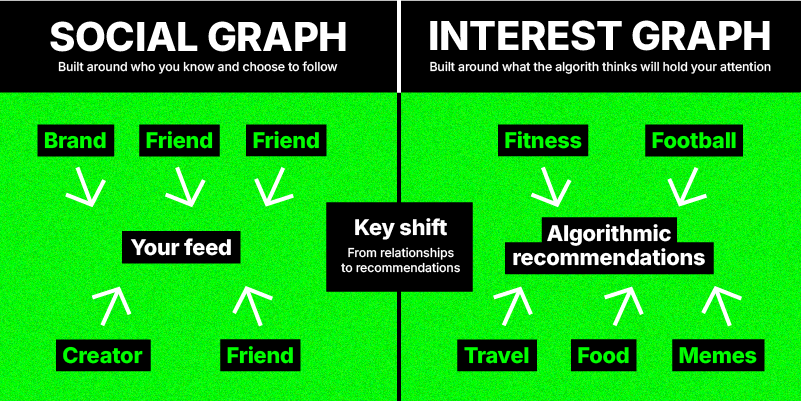
A - To answer that, we have to rewind to 2018. That was the year TikTok absorbed Musical.ly and began scaling globally around a very different idea of what a social platform could be. Instead of asking you to build a network of friends and followers first, TikTok opened with the For You feed: an algorithmic stream designed to learn what held your attention and serve you more of it. The organising principle was no longer who you know or who you follow. It was what you are likely to watch. That shift, from the social graph to the interest graph, is the defining break that has brought us to the post-social era.
“From that point on, the major platforms began converging on the same model: less social networking, more algorithmic entertainment, discovery and recommendation.”
THE STATE OF PLAY
Q - Okay, so is social media (as per that definition) dead?
A - Not dead, far from it. Social media is bigger than ever; it’s just no longer very social. The dominant logic has shifted from connecting you to people you chose to follow, to feeding you content an algorithm predicts you will want. What died was not social media, but the social graph as the organising principle.
Q - Right, but surely everyone has known this for years. Why are people now calling this the “Post-Social Era”?
A - You’re right. We’ve known for years that algorithms shape feeds. But it was TikTok’s way of doing things that won the battle for attention. Everyone else, one by one, just did the same thing: Facebook, Instagram, YouTube, LinkedIn, Pinterest, even Spotify, have all copied elements of TikTok because TikTok discovered a more efficient way of gobbling up attention.
The model is “recommendation” over “following”. That translates into creators over friends, consumption over participation, and discovery over connection. If you even need more proof, regulators are starting to intervene in recommender systems. It is now widely understood that this is the model.
Q - So the number of people following a brand doesn’t matter?
A- Follows are pretty much dead. In fact, likes don’t even really mean all that much. They are both nice to have, but dwell time on a carousel, watch time on a video, saving a video for later or sharing it with a friend. These are the metrics. A post from an account with a small following can travel far and wide if the algorithm sees strong signals of interest. And huge accounts can publish posts that go nowhere.
Q - Okay, so for a brand guardian, what does that mean?
A - Every brand is different. But the brands that are winning are reorganising around creators and cultural response. Remember, even though we call them social networks, they are algorithmic media systems.
For brands, that changes the question from “What do we want to publish to our audience?” to “What will the system choose to distribute, and why will people care when they encounter it?”
It’s a harder question, because you no longer fully control the sequence, the context or even the audience. Someone might encounter your brand through a creator, a reaction video, a meme, a repost, a comment or a piece of paid media before they ever see your original message.
Q - So “post-social” is really shorthand for a world where getting recommended is far more important than having followers. Being entertaining (or useful) replaces being connected. And creators have as much distribution as publishers?
A - Yes, exactly. Have you noticed that almost all digital publishers primarily live in social channels now, and not on websites? And they all have personalities (creators) that are central to their success. And the feed is the engine that distributes it all.
WHAT NOW?
Q - What does good look like now?
A - Well, a calendar of posts resized by platform with brand guidelines as the central element isn't going to snap anybody’s head back. Just sending the links for your media agency to turn around in five days isn’t distribution.
Q - So should brands post more?
A - It’s not about how much brands are posting. The question is, are they making anything that the algorithm thinks is worth distributing? In other words, will people watch it?
Q - Are content calendars dead too?
A - Not dead, just not the central organisational element. Social teams and agencies need to act more like newsrooms. You still have things you know are coming: launches, offers, campaigns, seasonal moments. But alongside that, you are constantly watching what people are talking about, what creators are doing, what is working for your brand, and what the platforms are rewarding.
Q - Decisions would have to be made quickly then?
A - For sure. The model is: Is this relevant to us? Do we have something worth saying or making? Who should make it: us, a creator, a partner? Should we put paid media behind it? Did it work, and what do we do next? The important bit is that creation, publishing, paid support and learning happen as one loop, not as separate departments handing work to each other.
Q - A brand would have to be pretty brave to adopt this?
A - Sure, the old model feels safe because everything is approved in advance. The post-social model asks a brand to pre-agree principles, then let teams make more decisions in real time. That means accepting a few uncomfortable things: not every execution will be perfectly polished; creators may express the brand in ways the brand team would not have written themselves; some ideas will be tested and dropped quickly; and the brand may need to respond to culture before there is time for a full approval chain.
Q - There is a lot of talk about culture. “Acting in culture”. “Culturally-led agencies”. What does that mean?
A - Yeah, “culture” does get a bit overused. But this is very relevant to the whole “post-social” era. For a brand, culture is the shared set of ideas, behaviours, and references that shape what people see as normal, relevant or desirable. Brands can’t just advertise their way into culture the way they could before the internet.
Q - Like lines from famous TV ads in the 90s that enter into popular culture?
A - Exactly. But now culture moves much faster, is fragmented and completely decentralised. So now brands have to borrow from culture, add to it and sometimes help change it. And on social media, creators, memes, language and subcultures all shape how a brand is understood. Remember, it is algorithms that influence which parts of culture get seen. So culture is not just the message; it is the context that gives the message meaning.
WHAT IT ALL ADDS UP TO
Q - This feels like a bit of a leap of faith.
A - It shouldn’t be if a brand is built on solid foundations. A strong and clear brand is so important for the post-social era. Utter confidence in the brand is key. As is a deep understanding of what the brand is and isn’t.
Ryanair is a good example. A joke about paying extra for a bag means very little on its own, but in the cultural context of Ryanair’s reputation, the joke becomes instantly legible and feels “on brand.” The message works because people already understand the wider story around the brand.
Q - Does this mean that all briefs should be a ‘make this an only “insert brand” could do thing’?
A - Not if that means “make something wildly original, unmistakably ours, culturally relevant, platform-native, low-risk, cheap, and can we see three routes by Tuesday?”
But the principle is right. “Only this brand could do it” should be the test at the end, not the brief at the start. The job is to find the truth, asset, tension or behaviour the brand genuinely owns, then build from that. Otherwise you just get generic creativity wearing a logo.
BRAND TAKEOUTS
Optimise for distribution.
The goal is no longer to fill the calendar. It is to make things people will actually watch, share, save, discuss or pass on.
Loosen executional control, strengthen brand clarity.
Brands need to move faster, work with creators and respond to culture, but that only works if the brand is clear enough to remain recognisable when the execution changes.
Bring creative, creators and media into one loop.
Paid, owned, earned and creator activity increasingly collide in the same feed. The brands that win will make, distribute and learn as one connected system rather than as separate handoffs.