

The Youth Lab
AI MIGHT SAVE US (BUT FIRST, WE HAVE TO SURVIVE IT)
The other side of the AI story is much bigger.
In Part One, AI Wants You Gone (But Not For The Reason You Think), we looked at what happens when AI becomes capable of doing the things humans do, but faster.For young people entering education, work and adulthood right now, the picture wasn’t particularly comforting. AI is already reshaping the jobs they’ll do, the skills they’ll need and what a career might even look like in ten or twenty years.
But that’s only half the story.
Because while we’ve become understandably obsessed with what AI might take from this generation, there’s another question worth asking:
What might it give them?
The most extraordinary promise of AI may not be machines learning to do what humans can.
It may be machines helping us do things we simply couldn’t do before.
And that’s where Part Two begins.
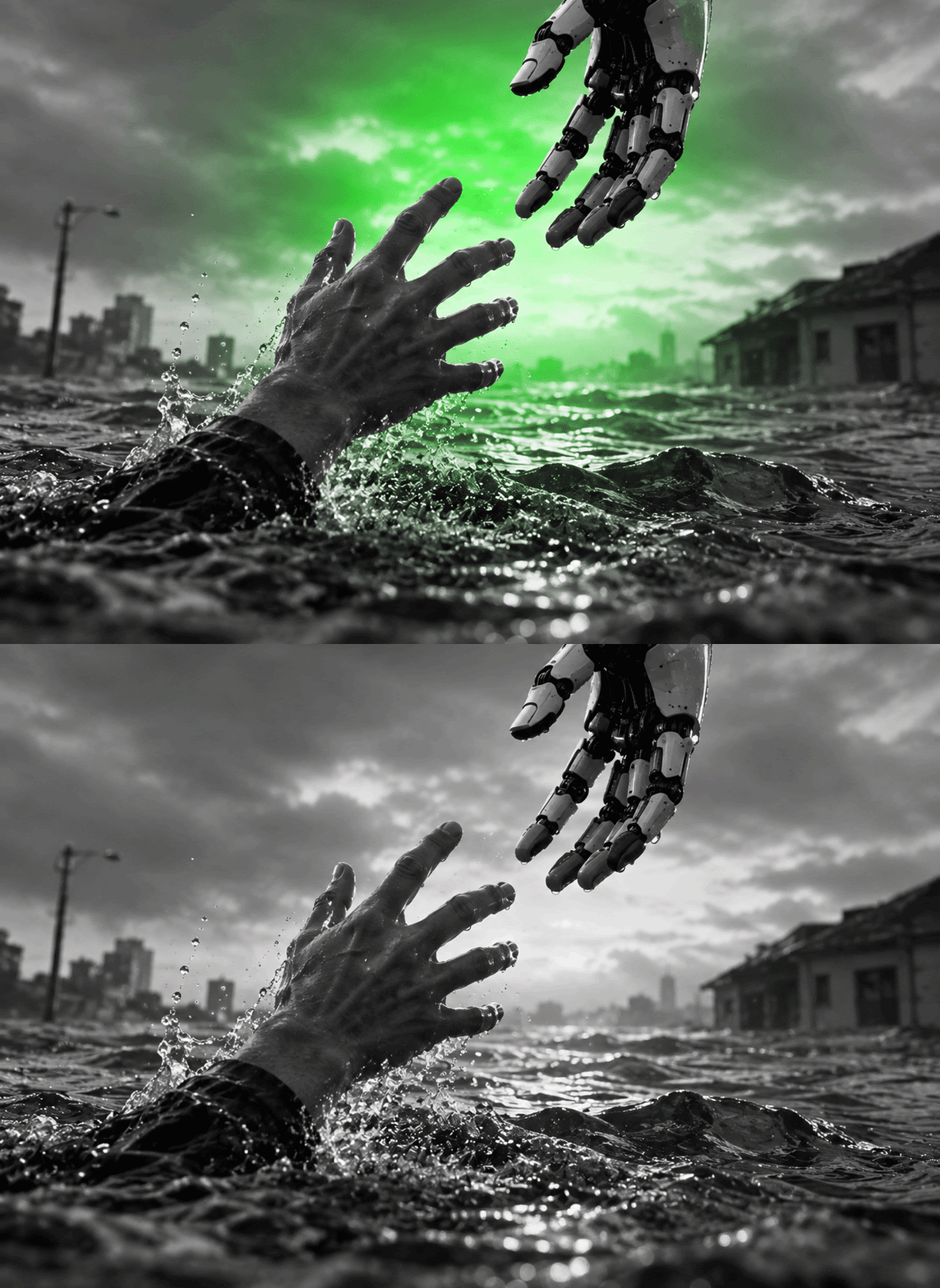
CONTEXT FOR US ALL
For most young people, AI still lives inside a prompt box.
It’s ChatGPT or Claude helping with an assignment. An image generator making something weird for the group chat. A tool summarising notes, rewriting an email or giving us the exact cooking time of a perfectly jammy boiled egg for your homemade ramen.
Useful, sometimes brilliant, occasionally wrong.
But this isn’t really a story about generative AI.
It’s a story about what happens when machine intelligence moves beyond the prompt box and into science, education, climate and discovery.
When most of us say AI now, we mean generative AI: ChatGPT, image generators, copilots.
But that’s only one part of the story.
Across science, medicine, climate and engineering, machine-learning systems are doing something very different: searching, predicting and testing possibilities at a scale humans simply can’t.
Scientists are using AI to search for new antibiotics. Researchers are mapping the structures of proteins at a scale that would have been unimaginable a generation ago. AI systems are predicting floods, analysing climate data and searching for materials that could survive the extreme conditions inside future fusion reactors.
Take antibiotic resistance.
In 2026, researchers supported by the US National Institutes of Health tested an AI system called ApexGo, designed to improve potential antibiotic compounds.
Of 100 AI-optimised peptides tested in the lab, 86 killed at least one type of bacteria. Two were later tested in mice infected with antibiotic-resistant bacteria and performed better than the compounds they started with.
The system didn’t just produce an interesting answer on a screen.
Scientists made what it suggested and tested it in the real world.
Humans are very good at asking questions.
What we’re not particularly good at is testing millions of possible answers at once.
AI can.
And that ability to search at a scale we simply can’t may turn out to be one of the defining capabilities of AI.
AI IS GETTING BIGGER THAN THE PROMPT BOX
Three things are starting to become clear.
First, AI is moving from helping us do things faster to helping us do things we couldn’t do before.
The consumer AI boom has made us think about the technology in strangely personal terms.
What can it write for me?
Can it do my job?
Can it make this presentation?
Can it pass this exam?
"I think my generation is beginning to realise that AI goes far beyond everyday convenience. AI is no longer just about doing things faster, but doing things we couldn't before. We're only scratching the surface of its potential, and I believe those who don't embrace it risk being left behind."
Rebecca Duffy, 23
Meanwhile, some of its most interesting applications are happening far away from the chatbot.
Google’s AI-powered flood forecasting, for example, now makes predictions across countries where more than two billion people live.
AlphaFold’s database contains more than 200 million predicted protein structures, giving scientists an extraordinary new way to investigate the machinery of life.
The bigger AI story may ultimately be less about convenience and more about capability.
Second, young people could inherit genuinely superhuman tools.
Not superhuman in the sci-fi sense.
In the very practical sense that a person can suddenly investigate more possibilities, process more information and ask bigger questions than they could before.
Think about education.
Grinds work because someone can sit beside you, figure out exactly where you’re stuck and explain something five different ways until one finally clicks.
Put a version of that on a teenager’s phone and personalised learning starts becoming available to people who could never afford grinds.
There are huge caveats.
It has to be accurate.
It has to be accessible.
The best versions can’t simply disappear behind expensive subscriptions.
But the possibility is there.
Third, there’s a catch.
And it’s a pretty big one.
The thing that makes AI powerful is also the thing that should make us nervous:
scale.
A system that can analyse millions of scientific possibilities can analyse millions of cyber vulnerabilities.
Technology capable of personalised education can also enable personalised manipulation.
Tools that let anyone create convincing content also let anyone create convincing misinformation.
Scale doesn’t particularly care what we use it for.
That part is still up to us.
NOW IMAGINE YOU’RE 20
You could reasonably live into the 2080s.
Which means your relationship with AI isn’t a tech trend you’ll experience for a few years.
It could be a 60-year relationship with a technology that is still in its infancy.
What becomes possible in that time is impossible to predict.
Some of today’s enormous AI promises will turn out to be nonsense.
Some breakthroughs will take decades longer than expected.
Others will arrive from places nobody is currently looking.
But the people building the most powerful systems are already telling us that capability alone isn’t enough.
In 2026, leaders including Sam Altman, Dario Amodei and Demis Hassabis publicly pushed for greater oversight of frontier AI, with common ground emerging around independent testing, safety standards and restrictions on systems considered too dangerous to release.
That doesn’t mean we should accept every proposal from AI companies uncritically.
Regulation can protect people.
It can also protect the enormous companies wealthy enough to comply with it.
The bigger point is harder to ignore.
Even the people racing to build more powerful AI systems believe there need to be rules around how powerful they become.
For young people, cautious optimism may be the most rational response.
Be excited about what these tools could unlock.
Be demanding about who controls them, who benefits from them and what happens when they get things wrong.
A VERY HUMAN DECISION
Young people don’t need another brand telling them that AI is exciting.
They know.
They’re already using it.
The more interesting opportunity is to stop talking about the technology itself and start showing what it enables.
What can somebody learn that they couldn’t learn before?
What can they make?
What problem can they solve?
What opportunity becomes accessible to someone who previously couldn’t afford it, reach it or imagine it?
Because “powered by AI” is rapidly becoming about as interesting as “powered by the internet”.
Trust will matter more.
That means being clear about where AI is being used, what it’s doing, why it’s useful and where its limitations are.
It also means knowing when the most reassuring thing you can tell somebody is that a human still gets the final say.
“I don't mind AI being used in a job application or at the doctor's, but I want to know a real person looked at it. If a computer turns you down, who do you even argue with?”
Alex Connell, 24
Young people have already lived through one generation of technology companies promising to connect the world, democratise information and make everything better.
They also saw what arrived alongside those promises.
They’re entitled to be sceptical this time.
But scepticism doesn’t have to mean pessimism.
This generation didn’t create climate change.
They didn’t create antibiotic resistance, the housing crisis or the energy crisis.
Yet they may be the first generation to inherit tools capable of attacking some of those problems at a scale previous generations simply couldn’t.
That is genuinely exciting.
It’s also a hell of a responsibility.
AI may give this generation capabilities no generation before them has ever had.
What they choose to do with them is still a very human decision.
BRAND TAKEOUT
Be real about the two-edged sword: Technological advancements are never 'good' or bad' in their own right. Its their usage, (as determined by humans), that drives their positive or negative impact. For the sake of young people, and all of us, let's lean more into exploring the good side of AI.