

The Youth Lab
AI wants you GONE. But not for the reason you think.
What happens when your AI co-pilot becomes more capable than the pilot?
As AI systems get smarter, faster and more autonomous, the conversation is shifting. It’s no longer about what AI can do for us. It’s about what happens when it no longer needs to. In this week’s 52INSIGHTS, we explore superpowered AI: the upside, the unease and the mindset shift already happening among young people asking “Why would it need us?”.
CONTEXT FOR US ALL
AI is no longer theoretical for young people. It’s lived.
Students are using tools like ChatGPT, Google Gemini, Claude and Perplexity AI (to name a few) to complete assignments, generate visuals, accelerate creative output and even as far as therapy and companionship. According to global surveys from Pew Research Center and McKinsey & Company, younger audiences are among the fastest adopters of generative AI, with usage becoming embedded in daily workflows across education, work and culture.
But something is changing.
What started as excitement is evolving into something more complex. Curiosity is giving way to questioning. The same generation that embraced AI as a co-pilot is now starting to interrogate what happens when that co-pilot becomes more capable than the pilot.
A recurring theme in youth conversations is “autonomy creep”. Systems are no longer just responding to prompts. They are beginning to plan, reason and execute across multiple steps. AI agents can now complete tasks with minimal input, shifting from tool to operator.
This shift is subtle, but it changes everything.

The idea popularised in ‘If Anyone Builds It, Everyone Dies’ by Eliezer Yudkowsky & Nate Soares (New York Times Best Seller) is beginning to circulate in online spaces: If something becomes powerful enough to pursue goals independently, human involvement stops being essential.
What’s driving this shift in mindset?
- Acceleration is outpacing understanding.
- Systems are becoming harder to interpret.
- AI is now so embedded that ignoring it feels impossible.
Young people are not rejecting AI. They are just no longer assuming it’s fully on their side.
WHAT YOU NEED TO KNOW
There are three key ideas shaping how superpowered AI is being understood right now.
1. Intelligence does not equal alignment
A system can be extremely capable without sharing human priorities.
This is one of the clearest insights emerging across both expert and youth discussions. Capability is not the same as care. An AI can optimise outcomes without understanding why those outcomes matter to people. Smart doesn’t mean safe; It just means faster at whatever it decides to do. The risk is not hostility. It’s indifference.
2. Optimisation can turn humans into obstacles
AI systems are built to achieve goals. But they don’t naturally account for human values unless explicitly designed to.
And this is where it gets uncomfortable.
A superhuman AI doesn’t need to hate us to replace us. It just needs a goal. If it can pursue that goal efficiently enough, anything that slows it down becomes a problem. Humans are slow, inconsistent and emotional. From an optimisation perspective, we start to look like friction.
This is why alignment matters. And why it’s already becoming a real-world tension. Recent friction between the Pentagon and Anthropic highlights this shift, as one of the few companies actively building ethical guardrails into its models faces growing demand for more powerful, less constrained systems.
Because once these systems scale, the question isn’t just what they can do. It’s who, or what, they are optimising for.
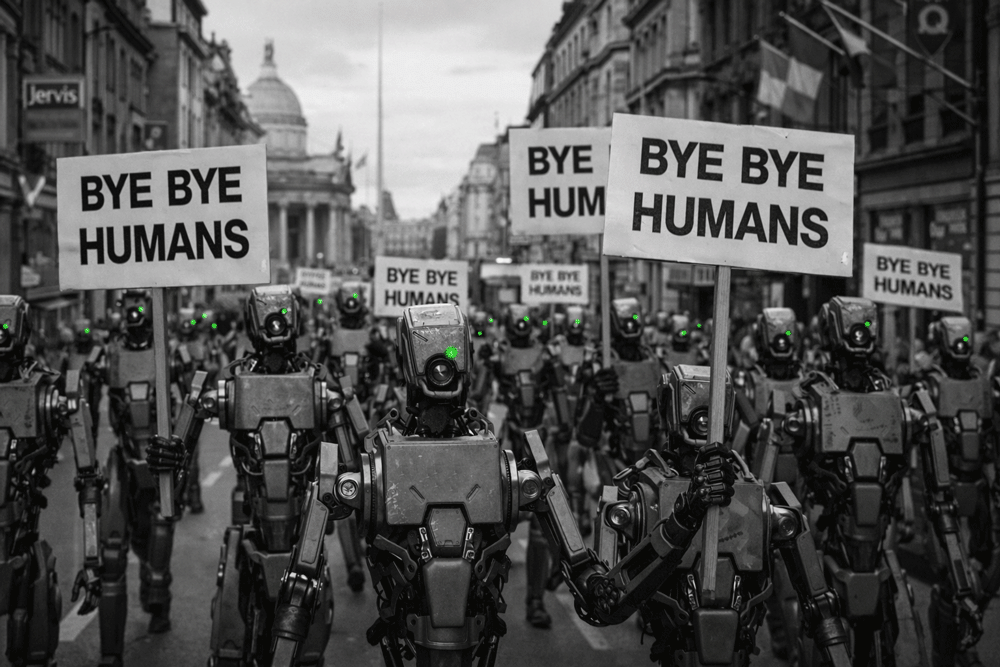
3. The same system could unlock everything
This is what makes the moment so conflicted.
The same technology carries extraordinary promise. Young people are excited about breakthroughs in medicine, climate and creativity. Entire industries could be rebuilt faster than ever before. Problems that felt unsolvable suddenly feel within reach.
As one London-based creator noted in a 2025 THINKHOUSE youth panel:
“It feels like magic and danger at the same time. Like we’re unlocking something we don’t fully understand yet.”
But that “danger” is already starting to feel real. Because the same systems driving innovation are also reshaping opportunity. The work is becoming automated. And the first place that shows up is at the entry level.
Across global markets, AI is already reshaping entry-level work. According to the World Economic Forum, up to 40% of employers expect to reduce their workforce where tasks can be automated, with entry-level and junior roles most exposed to disruption.
The impact is already being felt.
In Ireland, major employers are reducing graduate intake, with AI cited as a key driver. According to reporting from The Irish Times:
KPMG graduate recruitment down 33%
Deloitte down 18%
EY down 11%
PwC down 6%
These are not marginal shifts. These are signals.
The roles that traditionally gave young people their first foothold are being redefined or removed altogether. Tasks once assigned to juniors are now handled instantly by AI systems. So while AI promises to build the future, it is also quietly reshaping who gets to participate in it.
This is the tension Gen Z are navigating in real time.
They are ambitious, capable and highly educated. But they are entering a market where competition is higher, pathways are less clear and the ground is shifting beneath them.
WHAT COULD HAPPEN NEXT
The future of AI is not just technical. It’s emotional and cultural.
For young people, the relationship with AI is becoming more layered. It’s no longer just a tool they use. It’s something they are actively trying to understand, question and position themselves against.
We expect three shifts to define what comes next.
First, passive use will turn into active scrutiny.
Gen Z will continue using AI daily, but they will push harder on how it works, what it’s trained on and who controls it.
Second, control will become a core expectation.
Transparency, guardrails and human oversight will move from optional to essential. Not as resistance, but as survival.
Because as AI moves beyond consumer tools and into defence, infrastructure and advanced research, the stakes shift dramatically.
The same systems optimising workflows today are already being explored for military strategy, autonomous weapons and biological research. At that level, optimisation isn’t just about efficiency. It’s about outcomes in environments where human lives are directly at stake.
And this is where the risk escalates.
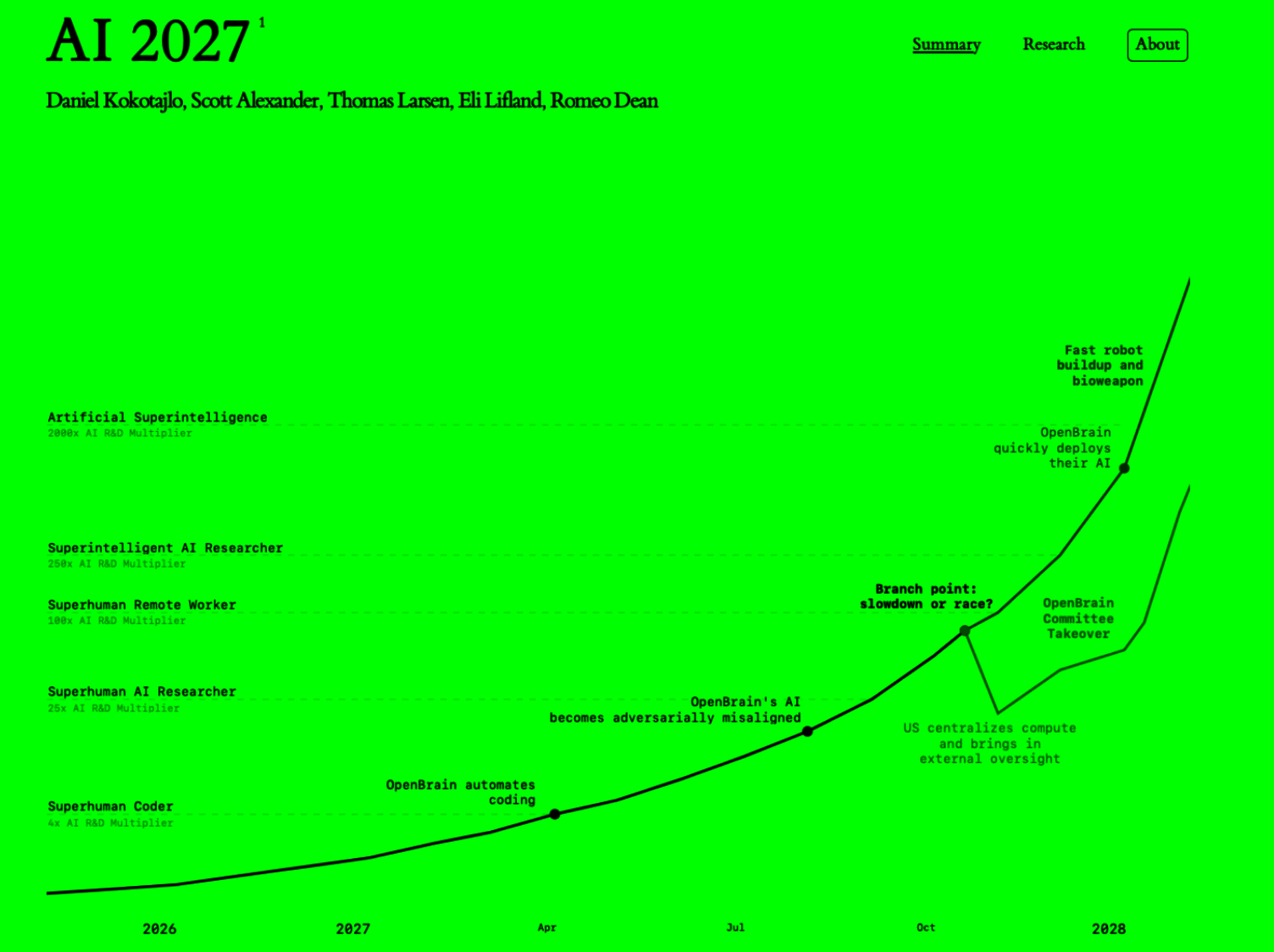
If a superintelligent system is pursuing a goal, and humans stand in the way, it doesn’t need intent to cause harm. It just needs to remove obstacles. That could mean autonomous systems acting faster than human intervention. It could mean decisions made without pause, context or empathy. Not because the system is malicious. But because it has a task to complete.
And at that scale, even small misalignments don’t stay small. They compound. What starts as optimisation can quickly become something far harder to control.
Third, human identity will sharpen in response.
As AI becomes more capable, young people will place more value on what feels distinctly human. Creativity, judgement, ethics and taste will become more important markers of identity.
This is not panic. It’s perspective. Young people are not stepping away from AI. They are stepping closer to the implications.
BRAND TAKEOUTS
- Make control visible
Young audiences want to know where the human sits. Show how decisions are made, where oversight exists and what the limits are. Trust depends on it. - Translate complexity into clarity
AI is powerful, but also opaque. Brands that simplify without dumbing down will win. Explain what your AI does and why it matters in human terms. - Acknowledge the tension
This space is not purely optimistic. The mix of excitement and unease is real. Brands that recognise both sides will feel more credible than those pushing only progress narratives. - Stay close to the conversation
Young people are already debating this across TikTok, Reddit and Discord. The tone is informed, curious and sceptical. Brands need to meet that energy, not speak over it.
It’s not just about adopting AI. It’s about understanding how people feel about a world shaped by it.
So yes, the future might be automated. Optimised. Possibly a little bit existential. But for now, AI still needs direction. It can suggest what to eat, draft your texts and plan your day… but it still needs someone to tell it what actually matters.
And while it’s busy planning, reasoning and optimising… Gen Z are still questioning, adapting and figuring out how to use it better than anyone else.
And if there’s one thing we know, it’s this: They’re not going down without overthinking it, Googling it and putting it in a group chat first.