

The Youth Lab
THE DUALITY OF GENERATIVE AI: ACCESS VS SLOP
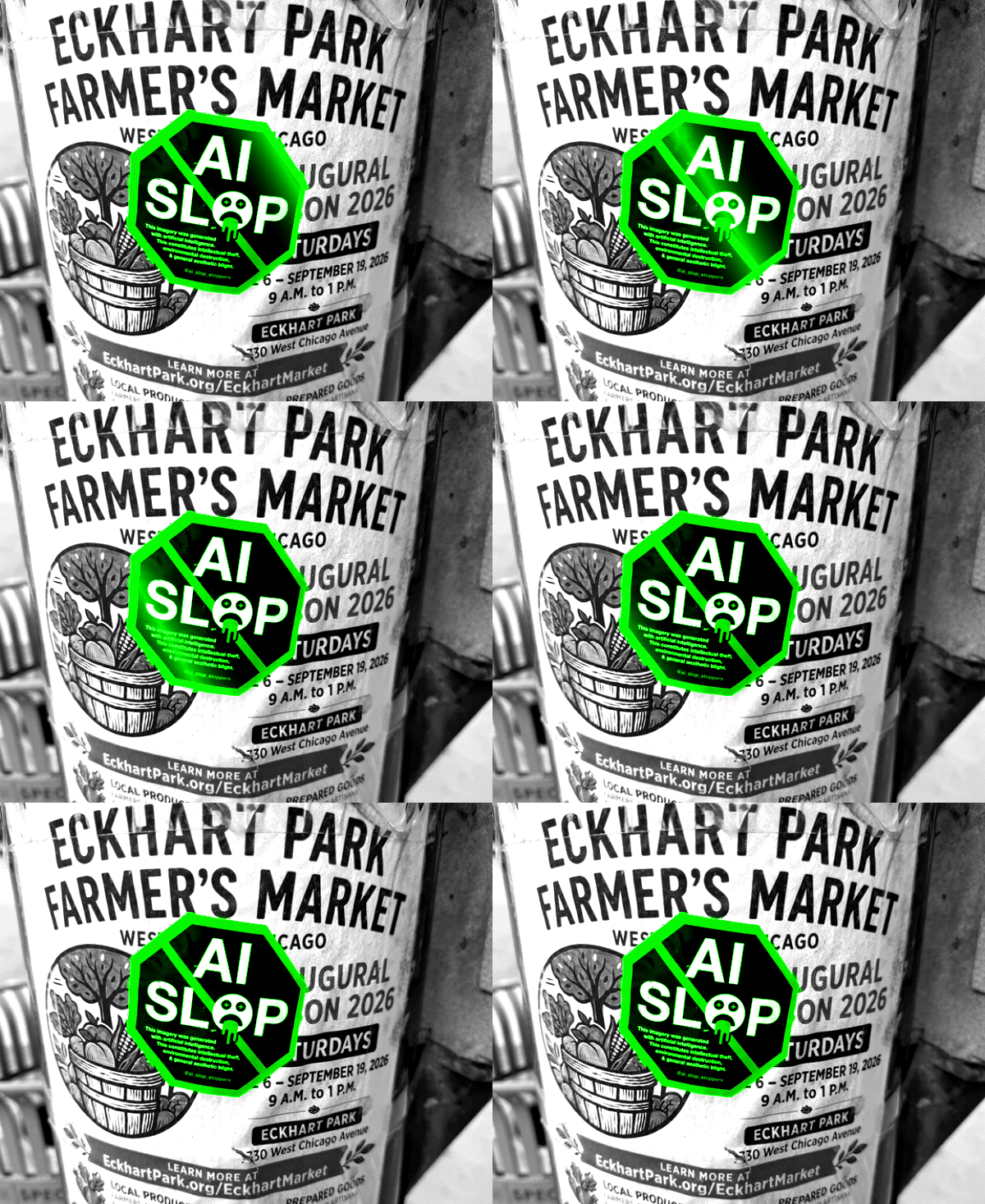
Scroll through r/ireland, r/melbourne or r/chicago and you'll find the same argument happening on three continents: growing numbers of people are sick of the AI posters going up in their local cafés, gyms and pubs. In Chicago the protest has gone offline, with anti-AI-slop stickers appearing around the city.
But here's the thing that makes this more than a design issue: a lot of the people complaining are the same people using the tools.
In this edition of 52INSIGHTS, we explore why young businesses and founders are increasingly adopting generative AI, why that same generation that is the loudest critic of it is also using it, and what the fight over data centres worldwide tells us about its cost.
First, the scale of it. US Chamber of Commerce data puts generative AI use among American small businesses at 58% in 2025, up from 23% in 2023. The OECD's figures are stricter and cover more countries, so the numbers are lower, but the growth is similar: going from 8.7% to 20.2% over the same two years. Per either metric, adoption has roughly tripled. And for SMEs, marketing materials - like posters, menus and social assets - have become a prime, and very public-facing, output.
For young business owners the maths isn't close. Branding thought leader Douglas Berger makes the point that these micro-businesses were never going to hire a designer in the first place. A musician getting €150 to €300 for a gig cannot reasonably spend €25 of it on a poster. So the choice was never AI versus a designer. It was AI versus nothing.
That's worth sitting with, because it explains why the tools spread so fast among people in their twenties launching things from a laptop. The World Economic Forum reckons the shift is comparable in scale to the printing press. For anyone starting out with no capital, AI isn't a convenience. It can be the difference between having a brand and not having one.
AI RAISES THE BAR, BUT NOT THE CEILING
So does it actually make the work better? Researchers ran a proper test of this, published in Science Advances that gave 293 people to produce a short story, and split them three ways: one group worked unaided, one could ask ChatGPT for a single three-sentence starting idea, and one could ask for up to five. Then 600 independent evaluators scored the results without being told who had help.
While the scores, as a whole rose, findings brought the true gains of AI use into question. The group given five AI-generated ideas to choose from saw novelty scores 8.1% higher than the unaided group, and usefulness scores 9.0% higher. The least naturally creative writers gained 10 to 11%, while the strongest writers gained almost nothing at all. AI raised the floor without touching the ceiling – and in doing so, it flattened the output with everyone’s work starting to look less and less distinct.
WHY YOUNG PEOPLE ARE ANNOYED
Brand guardians tend to hear this backlash as a complaint about quality, as if the answer could just be better prompts. But it’s not that simple. Reddit posts reveal four separate objections running at once - with only one about appearances.

1. It looks “off” and people can tell. Generative models don't have reasoning or unique perspectives. They predict what pixels usually go next to each other, rather than understanding margins, negative space or visual hierarchy the way a designer does. That's why the output has a recognisable layouts: cluttered designs, similar type, that same warm oversaturated tint.
2. The tools were built from other people's work. The models were trained on creative work scrapped without permission. For young creatives this is the sharpest objection by a distance, because the thing competing with them for jobs was assembled out of their peers' portfolios.
3. Someone didn't get paid. Every AI asset is a commission that didn't happen. Entry-level and young workers taking the heaviest hit. That's the macro version of the local designer who didn't get the poster job.
4. Known to make mistakes. This is one that could arguably cost businesses the most. When a café posts an AI image of a burger with impossible cheese and perfect lighting, the customer orders it and gets something else. Instead of demonstrating legitimacy and professionalism, the business runs the risk of saying "we couldn't be bothered showing you what we actually make."

CAUGHT ON BOTH SIDES
Which brings us to the contradiction at the heart of all the commentary. 76% of Gen Z have used generative AI, the highest of any generation, while also being 54% more likely than average to care - and complain - about its impact. On the surface it would be easy to write this off as hypocrisy, but that’s not the full story.
The publication Inc., on GoTo's 2026 Pulse of Work study, reported that 93% of Gen Z workers say AI has improved their day-to-day work. But 62% admit they lean on it too heavily, 46% say that reliance is eroding their actual skills, and half think their dependency will damage their career prospects down the line.
So this isn't a generation being inconsistent. It's a generation using a tool they don’t see a way to opt out of, while watching it close off the entry-level jobs they aspired to grow into. Stanford Digital Economy Lab found employment among 22–25-year-olds in the most AI-exposed occupations is already 19% behind their peers in less AI-exposed roles - driven primarily by reduced hiring.
Young people’s skepticism isn't just squeamishness about aesthetics, it's a view from the front line.
Which makes what happened in New York this month land a little differently. The city has banned generative AI for roughly 600,000 students from preschool through to secondary school. Mayor Zohran Mamdani framed it as protecting "human connection" in classrooms, arguing kids should build problem-solving and social skills with teachers and peers rather than leaning on tools.
Read that against the 46% fearing skills loss, and the timing of this is hard to ignore. For Gen Z, aged 13-28, protections like this might feel like too little, too late. But what education reform can't retroactively fix, employers and brands are now positioned to.
BRAND TAKEOUTS
For brands, the question is not whether to use AI. It is where AI supports their work without spending down trust.
Use AI for the floor, not the finish. Let it speed up drafts, layouts and options, but keep human judgement in charge of taste, truth and final output.
Never let AI misrepresent reality. Use AI for a poster if you must. Don't use it to show food, products or experiences that don't exist.
Back young creatives, visibly. The sourcing objection is the one this audience feels personally. Commissioning young illustrators and photographers for visible work is a sign of trust.
Measure the hidden cost. Treat prompts, storage and asset production as part of a brand's sustainability footprint. With 100+ moratoriums proposed globally, this is becoming a licence-to-operate issue, not a reporting one.
Score it before it goes live. The Higgins-Berger Scale gives teams shared language for transparency, harm, data, displacement and intent, before backlash rather than after.