Thinkhouse

The Youth Lab

THE POLITICS OF IDENTITY

As the World Cup continues to capture global attention, millions of young people are proudly wearing their national identity on their sleeves. Yet beyond the football pitch, questions of identity are also playing out in politics. This week, Ireland assumed the Presidency of the Council of the European Union for the next six months, placing questions of national identity, European identity and shared values firmly in the spotlight.

This edition of 52INSIGHTS explores what political identity means to young people today - and what Ireland’s young people want from Europe as the next generation of Europeans.

POLITICAL IDENTITY IS CULTURAL IDENTITY (AND VICE VERSA)
A brilliant LinkedIn article this week by Finian Murphy, Public Research and Communication Strategist at Core, introduced us to research from the Nanyang Technological University in Singapore. The global study of more than 10,600 people across 26 countries found that political ideology identity is increasingly shaping cultural preferences - not just political ones. Researchers discovered that people with more liberal views were more likely to prefer Lionel Messi, while those with more conservative views tended to favour Cristiano Ronaldo, even after accounting for factors such as age, education and personality.

Most strikingly, this relationship was strongest among younger generations, suggesting that political identity is becoming an increasingly important lens through which young people interpret culture. The research highlights a broader shift: politics is no longer confined to elections or policy - it is increasingly influencing the creators, communities, brands and cultural figures young people identify with.

In other words, politics is increasingly embedded in how they see themselves, the values they align with and the future they expect politicians and institutions to realise. Which makes moments like now - when Ireland assumes the EU Presidency - particularly significant for a generation already deeply invested in political issues and outcomes.

WHAT THIS MEANS FOR IRELAND’S EU PRESIDENCY

The official Presidency programme focuses on competitiveness, values and security, under the banner of "Ní neart go cur le chéile" ("Strength with unity").

Delivering a successful Presidency relies on good cooperation among Member States and with the Union’s other institutions. It also means considering and delivering on the needs of the 450 million people who call the European Union home, of which approximately 100 million are young people between the ages of 16-35-year-olds.

Growing up in an increasingly volatile and crisis-riddled world, young people aren’t keen to be passive observers of the political process. They don’t just want to be the recipients of policy or inheritors of a future they can’t see themselves in. More and more, today’s youth want to be active participants in shaping politics. As Aisling Maloney, UN Youth Delegate and Board Member of the European Youth Forum says,

"For the next six months, Ireland holds the Presidency of the Council of the EU, a milestone that coincides with the beginning of my mandate as a Board Member of the European Youth Forum. These two roles share a common purpose: bringing people together to find common ground. As Europe’s leaders discuss our shared future, solidarity and the responsibility we carry together, it is vital that they remember the decisions made today will shape the future my generation inherits. Young people must be meaningfully involved in shaping those decisions from the outset, on everything from education and housing to digital rights and the future of work. We are not just the leaders of tomorrow, but the stakeholders of today.”

From left: Carla Fusciardi Wallace, UN Youth Delegate of Ireland; Aisling Maloney, UN Youth Delegate and Board Member of the European Youth Forum; and Leo Galvin, National Youth Council of Ireland’s EU Youth Delegate, at the launch of Ireland’s Presidency of the Council of the European Union, in Dublin Castle, July 1st.

“THE EUROPE THAT WE WANT”

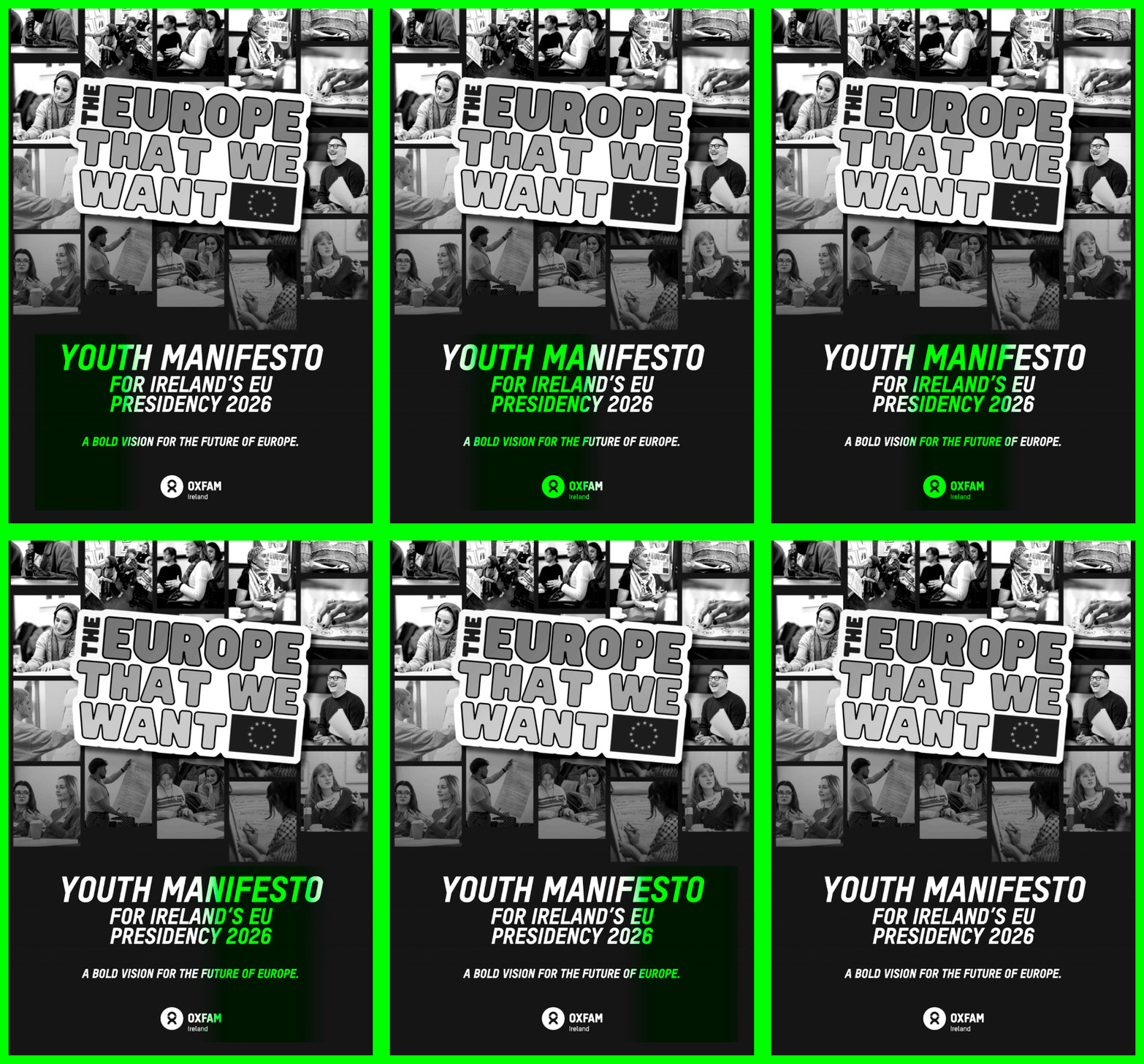
While many young people were present at the inaugural launch of the Presidency, they were also busy on the eve of the Presidency, presenting "The Europe That We Want" Youth Manifesto to elected representatives.

If the first insight in this edition shows us that politics is increasingly intertwined with youth identity, this manifesto demonstrates the reverse is also true: young people’s values, experiences, ambitions and challenges are actively shaping their political agenda.

The manifesto, developed through a youth-led initiative facilitated by Oxfam Ireland, offers a compelling snapshot of what many young people want from Europe: stronger action on climate justice, human rights, equality and inclusion, prioritising an economy of care over one driven by self-interest.

Specifically, they called for:

On housing and homelessness: “This is no longer a ‘Housing Crisis’ - it is a ‘Housing Emergency...The EU must declare this emergency and take action.’ - Liam Cosgrove, Dublin.

On climate justice and nature restoration: "Climate justice and nature restoration are deeply connected, and young people across Ireland see that clearly… If the EU falls short, it will be our generation that lives with the consequences." - Louisa Tyrrell, Wicklow

On corporate accountability: "At the core of corporate accountability is whether companies internalise the cost of harm they cause, or pass it on to workers, consumers and the planet. It's often the latter. Many human rights, environmental and social justice issues stem from a system that prioritises the powerful over ordinary people." - Erin O’Riordan, Cork

On Palestine & Israel: “We urge you to pass the Occupied Territories Bill and work towards EU-wide sanctions on Israel, including suspending the EU-Israel Association Agreement. Use every available means to end the blockade of Gaza, support Palestinian civil society, and advance recognition of Palestine." - Meklit Aragaw, Galway

On Diversity, Migration and Inclusion: "Migration has become heavily securitised, and new proposals such as Return Hubs risk human rights violations. Europe is becoming more diverse and inclusive, yet conversion therapy remains legal in many countries, including Ireland. We need policies that put human rights and inclusion first." - Emily Guinane, Cork

Read The Europe That We Want Full Manifesto here.

THE YOUTH OPPORTUNITY

Ireland’s Presidency comes with a unique opportunity to shape not just policy outcomes, but how young people participate in European democracy itself. This September, Dublin will host the European Union Youth Conference 2026, bringing together hundreds of young delegates from across Europe to directly engage policymakers on the future of youth participation - a signal that youth voice is increasingly moving from consultation towards real political influence.

Beyond September and Ireland’s EU Presidency itself, 2027 marks the end of the current EU Youth Strategy (2019-2027) - the framework that has shaped youth policy across Europe for the better part of the past decade, covering everything from education and employment to wellbeing, inclusion and democratic participation.

A key part of this is the Young Voices programme, Ireland’s national presentation of the wider EU Youth Dialogue - an initiative under the EU Youth Strategy designed to ensure young people have a direct say in shaping the policies that affect their lives.

As conversations begin around what comes next, Ireland now finds itself in a rare position to help influence how Europe engages young people for years to come. At a moment when trust in democratic institutions is increasingly fragile, empowering young people to participate meaningfully in politics may prove one of this Presidency’s most important long-term legacies.

BRAND TAKEOUTS:

Restore the faith: If Ireland can make meaningful progress on the issues highlighted by young people during the Presidency, Europe can show young voters that democracy can still deliver.

Enable participation: As political, cultural and personal identity becomes more intertwined, young people are expecting clear modes to participate and shape the policies defining their lives.

Listen up: For brands and businesses, it’s never been more important to hear from young people, understand the forces influencing their identity and show up in ways that recognise them as key stakeholders of today, not just leaders of tomorrow.

Mark your calendars: The EU Youth Conference comes to Dublin this September 17-30, 2026.

Ní neart go cur le chéile.