Thinkhouse

The Youth Lab

COMFORT IN THE CHAOS?

Decoding Near Nostalgia, Doom Spending & Humanoid Robots

Still getting over Justin Bieber sharing the stage with a younger version of himself at Coachella - a throwback to 2007, when Bieber first appeared on YouTube as a kid - we’re finding ourselves gripped by nostalgia. Then Billie Eilish, a self-confessed Belieber, shared her own throwback to her peak 2014 fandom, after living out a full-circle moment on stage with her idol. Cue internet meltdown.

But for Gen Z, nostalgia doesn’t have to reach that far back. Call it ‘near nostalgia’: the emotional pull toward a past that’s only just passed. Not childhood or heritage, but the moments, aesthetics and versions of ourselves from just a few years ago - summer 2019, winter 2024, even last year.

It’s nostalgia without the distance. And it’s on the rise, as each year brings more chaos, uncertainty and instability. This week’s 52INSIGHTS decodes the near nostalgia phenomenon - and other ways young people are finding comfort in the chaos of 2026.

NEAR NOSTALGIA ON THE RISE - WHY NOW?

One example of mass engagement with near nostalgia is the recent resurgence of 2016 internet culture, with people reposting their own photos, memes and playlists from that year at the start of 2026. Despite being less than a decade ago, it’s being reframed as a “simpler time”-a pre-pandemic, pre-AI moment-showing how quickly even the recent past can take on nostalgic weight.

In periods of instability - economic pressure, cultural fragmentation, a constant sense of flux - people look for grounding. In this year’s Youth Culture Uncovered, we highlighted ‘The Paradox of Now’ - the need to both speed up and slow down at a time of huge uncertainty. For young people, looking back on happier, safer, or more stable times is emotionally comforting, with the past acting as an emotional anchor.

But with culture moving faster than ever, our yearning for the past is now really a yearning for what was recent, but better. With trends now burning out in weeks, even days, the distance between “current” and “past” has collapsed. A look, a sound, a moment can feel dated almost as soon as it peaks.

At the same time, platforms are flattening time. On TikTok and beyond, nothing ever really disappears. Old content resurfaces, trends re-emerge without context, and the past sits alongside the present in a constant loop. In some ways, it’s almost like the past alongside the present helps us feel safer in the now - peak Coachella example of a live merging of the eras, collapsing generational distance into a memorable moment: Madonna and Sabrina Carpenter…

NOSTALGIA FOR A LIFE YOU’VE NEVER LIVED

So, while young people may be reminiscing fondly over recent summers, they’re also feeling nostalgic for a time, place, or era they’ve never actually experienced or lived through. Enter the term anemoia to the lexicon (sometimes called "fostalgia," or false nostalgia).

For teens and young twenty-somethings, born in the 2000s/ 2010s, there is a sense that the ‘80s and ‘90s were safer and more carefree decades, free of social media and mobiles, and hyper-connected, hyper-fast lifestyles. Going back to the ‘80s is escaping the present, but it’s also a curiosity about life pre-social media, and the ‘80s aesthetics is definitely a draw for the visually aesthetic Gen Zers. Little wonder why Pinterest’s new brand campaign film reflects on the freedom and connection of a pre-social media world - using old home movies and family photos from its employees’ archives - the beginning of a broader campaign about helping people get off their phones and into real life.

And in a world of false news, deep fakes and AI-generated synthetic content, the feeling of connecting with something you already know (or feels safe to know) is definitely a win.

“What comes to mind when someone says ‘nostalgia’ is Stranger Things. Stranger Things is a show based in the ‘80s with a massive fan base. Interestingly, the majority of their fans are 18-29 year olds. People who weren't even alive in the ‘80s.”
Cara, 16, The Love Network - The Youth Lab

DOOMSPENDING FOR A SHORT-TERM EMOTIONAL REWARD

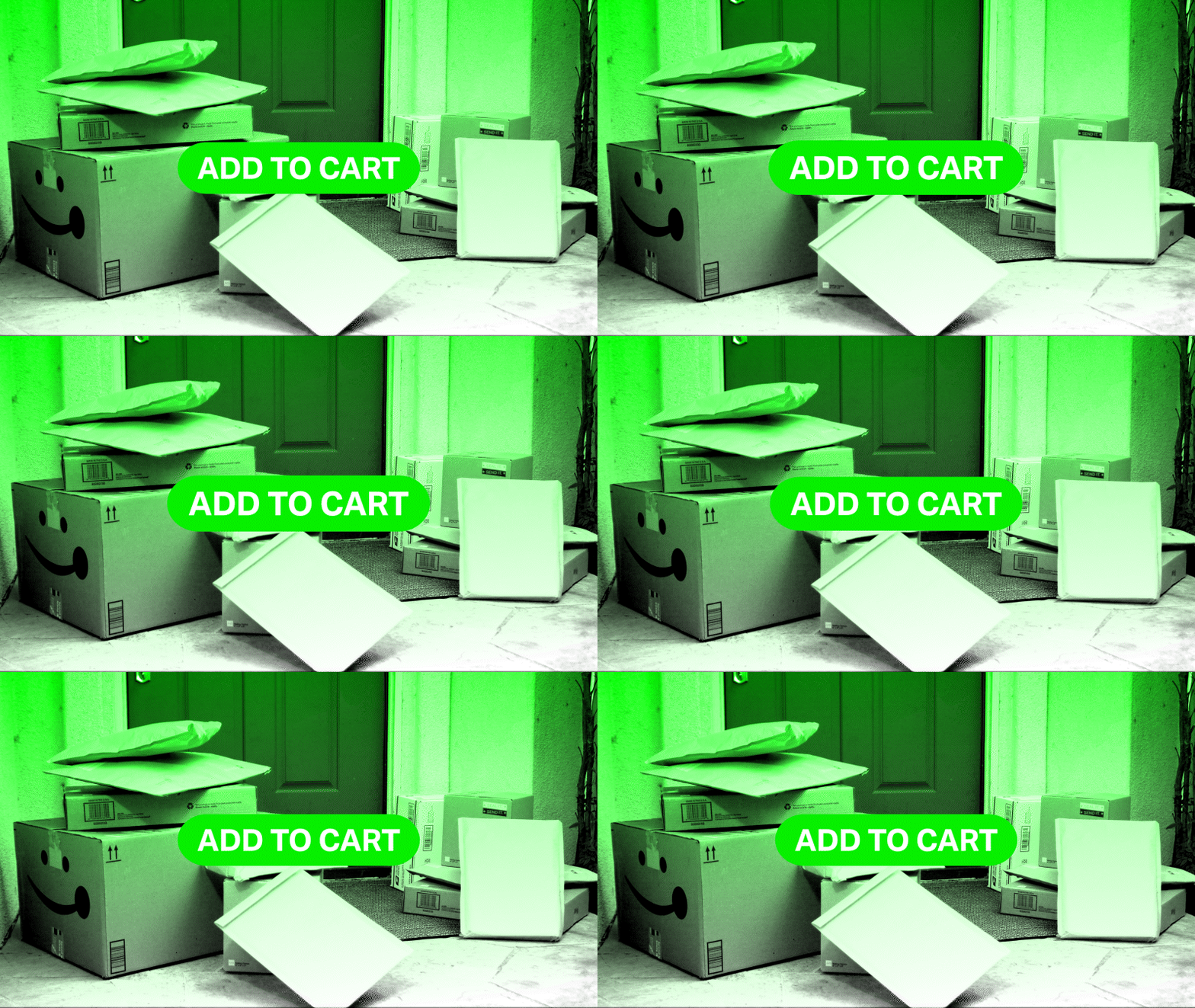
Another way younger generations are responding to the chaos of today is doomspending.

“We've seen that Gen Z is a generation defined by instant gratification. Of course, they would love to own a home one day, but for now, that doesn’t always feel attainable. What does feel within reach is booking the holiday they’ve always wanted, or treating themselves to new beauty products or clothes. These are the things bringing happiness in the here and now, especially for those just stepping into the workforce full time.”
Blessing Dosunmu, The Youth Lab

The clue is in the name - doomspending is spending money impulsively or excessively as a way to cope with stress, uncertainty, or negative news about the future. And according to the Financial Times, it’s “shockingly common”. Data from Ipsos in 2024 showed that 1 in 2 UK adults engage in this behaviour, rising to 67% among Gen Z and Millennials. Our bet is an upward trend on this behaviour for 2026.

While it can serve as a short-term emotional reward, it often leads to greater financial anxiety in the long term. But in the context of today’s chaos, “treating yourself” can feel like the perfect antidote - offering a sense of control when everything else feels unstable. And of course, in our digitised culture of over-consumption, it’s so easy to make an impulse shop - TikTok Shop's global Gross Merchandise Value (GMV) reached approximately $64.3 billion in 2025, marking a 94% year-over-year increase from 2024, spurred on by the $560 billion Buy Now Pay Later (BNPL) marketplace.

More broadly speaking, and highlighted in our Youth Culture Uncovered 2026 findings, many young people see traditional milestones of success - home ownership, pensions - can feel increasingly out of reach or irrelevant. Instead, more immediate, modern milestones like travel or experiences rooted in community and connection feel more aligned with their economic reality. After all, why save for a future that feels so uncertain when a memorable trip to [insert amazing foreign destination] delivers purpose and meaning in the now?

RUNNING ROBOTS - A LIGHT RELIEF TO AI OVERWHELM

In this age of acceleration, when technology is speeding up the pace of life and reshaping how we all live, work and play, the pace of change can feel overwhelming. The media narrative of the “Human Vs Machine” can make AI advancements - hidden beneath the bedrock of the internet and digital systems - abstract, unsettling, and even scary. But robots might be the key to our calm. Running robots, to be precise.

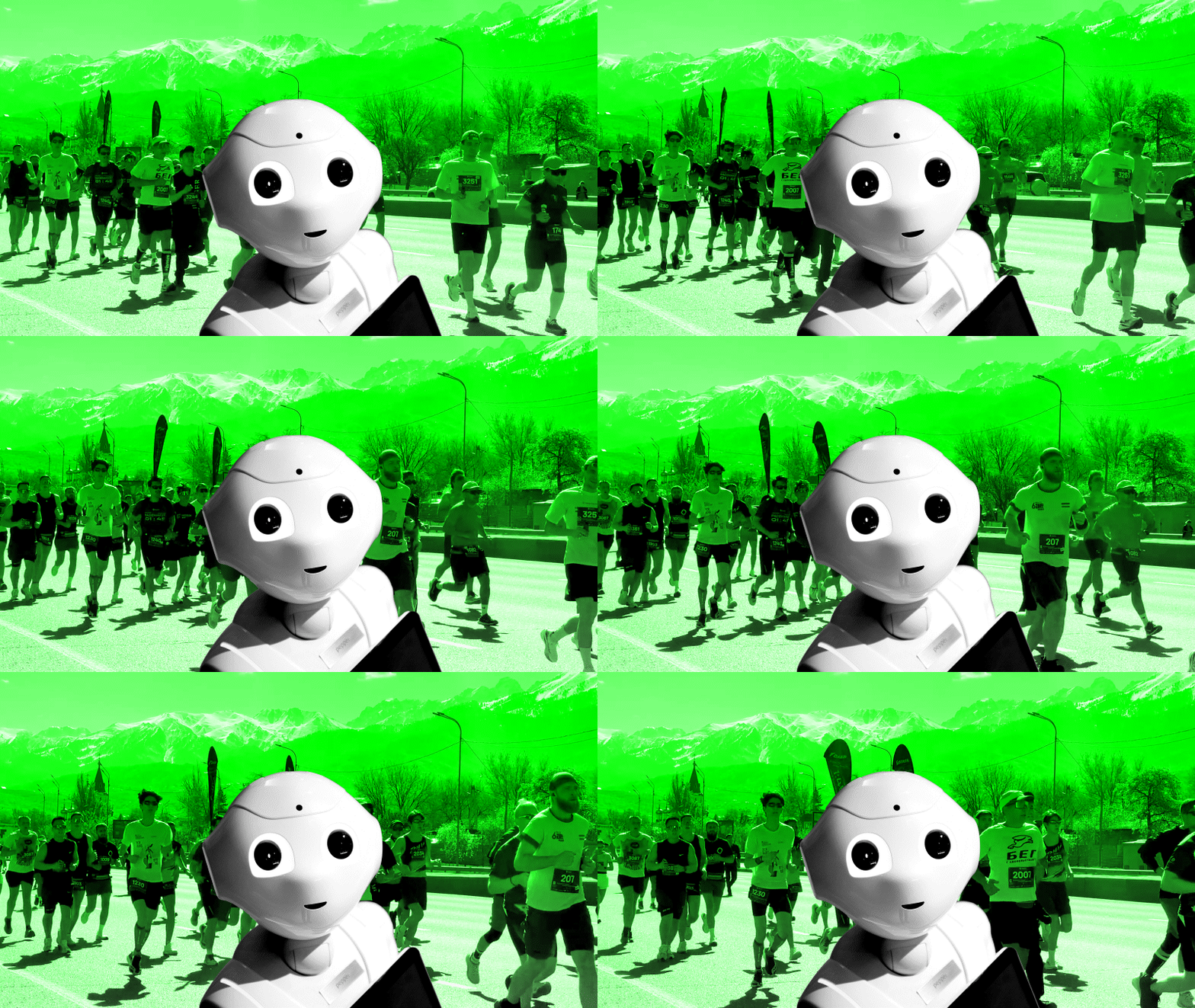
If you watch one thing this week, make it the chaos compilation from the Beijing Humanoid Robot Half Marathon. Designed to showcase how far humanoid robotics has come, it ended up becoming one of the most entertaining tech events of the year, helping to quell the rising “anti-AI innovation without regulation” sentiment.

“Blue pants one (sic) the crow’s heart but he could never be champion.”
- @r3d.official

There’s something undeniably human about watching robots move, wobble, fall, and try again. But it’s not just their physical presence, it’s HOW they actually look - “Blue pants robot” makes you want to run over and give him [it] a slice of orange to help him [it] over the last mile - right?”

That visible effort, with the uncannily human look, creates a connection AI rarely does. It feels less like machine intelligence, and more like shared experience. Last year, the internet revelled in robots failing to make it off the starting line. This year, some of the humanoid robots outpaced human runners. And while they may look endearing, the reality is that technological progress is still moving at breakneck speed - in this case medal-winning speed. And maybe that’s the paradox: the more human robots appear, the more comfortable we feel with just how fast everything is changing. And for the generation who are primed for everyday entertainment, let’s take their cue and just enjoy the entertainment…

BRAND TAKEOUTS:

Bring emotional reward in the here and now:
In a world of near nostalgia and doomspending, value is shifting from long-term aspiration to short-term emotional payoff. People are no longer waiting for big milestones. They’re seeking moments of comfort, reward and meaning now. What moments can you facilitate now that bring joy and comfort?

Blend eras for emotional safety and delight:
Nostalgia isn’t simply about looking back - increasingly it’s about the blending of eras - the old and the new simultaneously. Be inspired by Madonna and Sabrina and consider what remix opportunities you can bring to life.

Make the shiny tech a little less shiny:
Cute running robots draw on the heartstrings - who isn’t rooting for the lil’ tin can who gets up and tries again? Rather than always showcasing tech as the shiny, new toy, consider how best to humanise it through imperfection. You might just get greater engagement.