

The Youth Lab
Enshittification: How Everything Got Worse and How to Fix It
The Internet is getting worse for young people. But brands can help fix it.
If you’ve spent any time online lately, you’ve probably felt it: the apps and platforms we once loved feel… worse. They’re more cluttered, more manipulative, more exhausting. Every scroll feels a little heavier. The memes still slap, but the joy is harder to find.
There’s a name for this creeping digital decay. Enshittification - coined by writer and activist Cory Doctorow from his book of the same name. The term was named Macquarie Dictionary’s word of the year in 2024 and has sparked discussion everywhere lately, from The New York Times to the pages of Reddit. This edition of 52INSIGHTS explores what the term means, how it affects young people and what brands and organisations can do to help fix it.
enshittification
noun | in-shit-uh-fuh-KAY-shun
“The gradual deterioration of a service or product brought about by a reduction in the quality of service provided, especially of an online platform, and as a consequence of profit-seeking.”
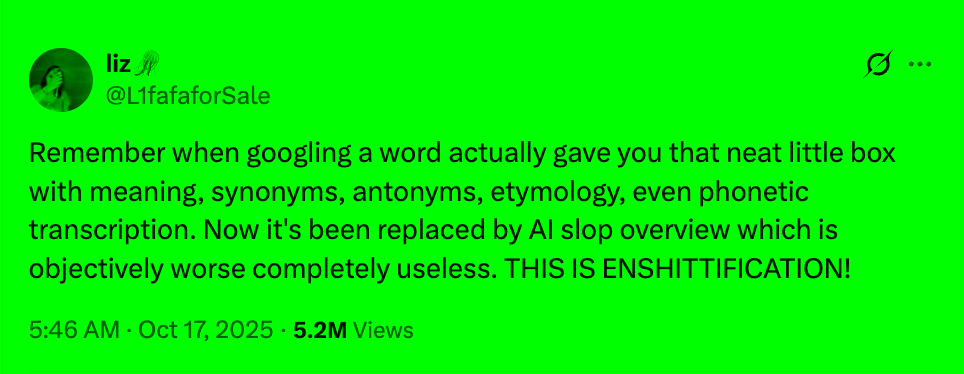
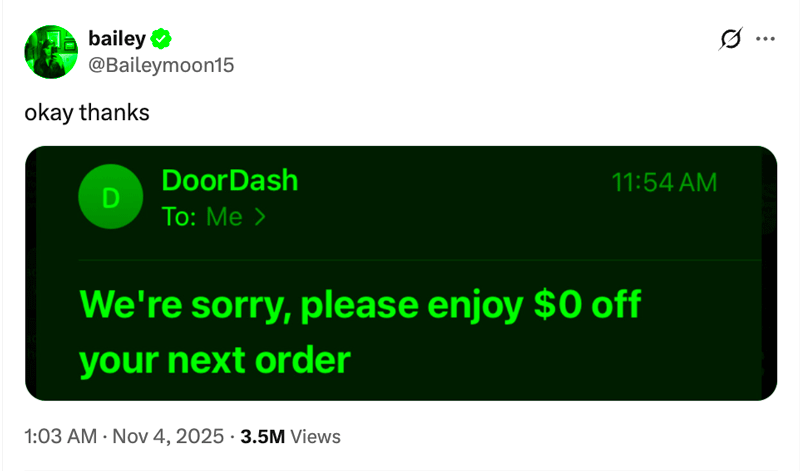
In his bestselling book, Doctorow argues that the pattern of enshittification follows a series of stages. It describes the process where platforms that start out serving users eventually optimise for profit, first squeezing users, then creators, then advertisers, until no one’s really winning except shareholders. Writer Hugh Linehan wrote about the topic recently in The Irish Times arguing that “enshittification seems to sum up a current mood, a sense of promises broken, not just in technology but in culture and politics too.”
The spread of enshittification in tech and products hits young people disproportionately because they’re deeply embedded in digital environments and consistently the first to adopt new services, meaning they feel the negative side-effects earlier and more intensely. Gen Z spend heavier amounts of time on social apps and mobile platforms: 94 % of Gen Z in a recent study said they use at least one social network daily. When products prioritise “growth at all costs” over user flourishing, younger users face “tech fatigue”, loss of trust, data-exhaustion or even mental health stress, making the stakes for reversing enshittification especially high for this generation. But this isn’t a doomed story, especially if brands, creators, and organisations decide to do things differently. In a Vox article interview last week titled ‘Why every website you used to love is getting worse’, Doctorow himself even closed out on a hopeful note.
“The future isn’t a place we discover, it’s a place we make. We can build a coalition with enough mass to change the rules”
THE OPPORTUNITY: YOUNG PEOPLE CHANGING THE RULES
After years of watching platforms, politics, and corporations shape a digital world that feels more extractive than empowering, a new generation is ready to take back control through design, collaboration and culture. It’s a reminder that the internet (and the systems around it) are human-made and therefore, changeable.
The question is: how do youth, creatives, activists and brands who care make a better one? The first step is in their collective unity. Gen Z are more likely to participate in consumer boycotts than any other generation, according to The Guardian.
Brands still hold massive cultural power, and young people know it. But that power can be redirected. And their vocal dissatisfaction with tech services is gradually having a positive impact.
DEMANDING BETTER
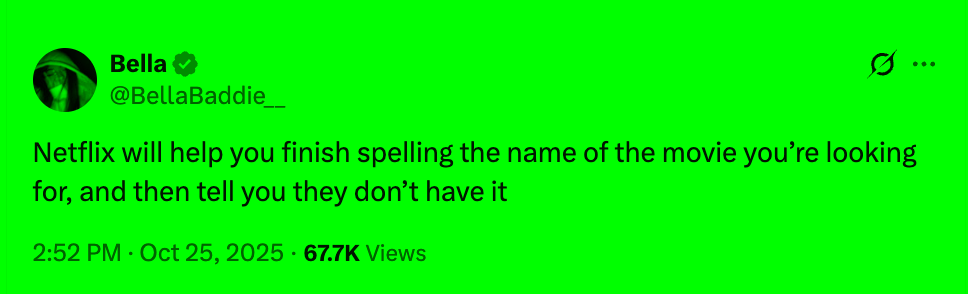
Last week Adam Mosseri, Head of Instagram, finally announced the introduction of a Reels Watch History for users after years of consumer requests. “You can now find all those reels you once saw but never knew how to get back to” said Mosseri in a short video to much appreciation. User feedback ranged unanimously from “this is an awesome feature” to “this is the best thing that’s happened to me all week”. Later in the week, Mosseri also announced the platform was starting to test the ability for users to see and control their own algorithm, a significant shift that suggests Instagram is listening to young people and potentially starting to reverse one of the core mechanics of enshittification.
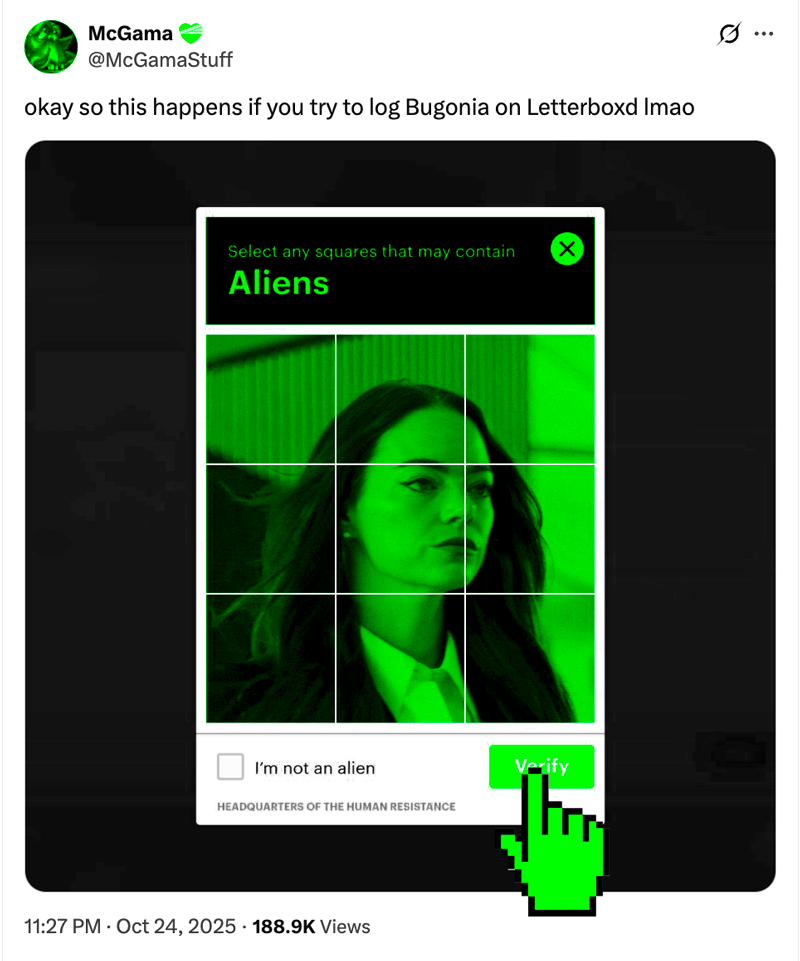
Letterboxd, the movie review app defined as “the Gen Z fad that might just save cinema” is a textbook example of the antidote to everything broken about the modern internet. It’s a platform that gives more than it takes, built around genuine enthusiasm, not engagement metrics. The UX is stripped-back and deeply human: no algorithmic manipulation, no dark patterns, no forced virality. Just people sharing what they love (and hate) about films. There’s joy in the simplicity - reviews are funny, weird, emotional, and wonderfully unpolished. In a digital landscape full of apps trying to monetise attention, Letterboxd has quietly become a sacred space for Gen Z cinephiles, a reminder that community, creativity, and curation can still exist online without the enshittification tax.
BRAND TAKEOUTS
Reward Contribution and Collaboration: One of the biggest anti-enshittification moves is turning users into co-creators. Lego’s hugely popular IDEAS platform invites fans to submit new product concepts, with real royalties for chosen designs. The company also provides free digital design tools and an open API for 3D builders. Similarly, CIE’s Youth Advisory Board (an initiative powered by THINKHOUSE) involves young people in a meaningful consultation role to reimagine the future of Ireland’s public transport system.
Have Young People Advise on Tech and Innovation: Public service broadcasters are actually leading the way on youth participation initiatives. ARD in Germany runs an annual youth media day where young people can learn about broadcasting, design livestreams and build streaming platforms under the theme of ‘Democracy and You!’. In the USA, Vegas PBS runs the Media Crew project to involve students in every stage of content production and distribution and hear their views and ideas on emerging technology platforms to engage younger audiences where they are.
Stick to Brand Principles: Sticking to strong brand and marketing principles is one of the most effective safeguards against enshittification, acting as a moral compass in a data-driven world. Drinks brand Arizona Iced Tea’s consumer promise to keep their popular product at the affordable price of 99c hasn’t wavered for over three decades, becoming an integral part of the company’s identity. Staying loyal and honest to your core values and creating products and experiences that age well will earn consumer loyalty.
THINKHOUSE NEWS
This week we were front row at Google HQ for the YouTube for Athletes event. Our Director of PR & The Love Network, Lucy Carroll, joined an incredible panel to explore how athletes can grow and monetise their channels on YouTube. We spoke about the power of creator collaborations where authenticity, trust and creative freedom wins every time.
We can’t wait for the next one…